Bank Statement Parsing Benchmark
The first open benchmark for measuring bank statement extraction accuracy. 15 synthetic statements, 36 parsing challenges, 12 countries, across 3 difficulty tiers.

Open Benchmark Leaderboard
One row per tool, aggregated across its scores on our released open-benchmark statements (bsb-001..bsb-005) — the same statements are freely downloadable, so any tool's ranking here is independently reproducible.
Bankstatementconverter.com
Bankstatementconverter.com
Bankstatemently
Bankstatemently
Claude Sonnet 4
Claude Sonnet 4
Bankstatementwizard.com
Bankstatementwizard.com
Convertbankstatement.io
Convertbankstatement.io
Llamaindex.ai
Llamaindex.ai
ChatGPT - GPT-5
ChatGPT - GPT-5
Statemently.ai
Statemently.ai
Statementconvert.com
Statementconvert.com
What we benchmark
Extraction
Turning a bank statement PDF into clean, accurate transaction data — the leaderboard above.
Entity resolution
Coming soonCan the tool make sense of the corpus — match accounts, products, and transfers across documents?
Submit your tool
Score your own tool against the released statements and add it to the leaderboard.
Submission instructions on GitHubQuick Start
Get started in three steps.
curl -O https://bankstatemently.com/benchmark/statements/bsb-001-statement.pdf
your-parser bsb-001-statement.pdf > result.jsonHASH=$(shasum -a 256 bsb-001-statement.pdf | cut -d' ' -f1)
curl -X POST https://api.bankstatemently.com/v1/benchmark/evaluate \
-H "Content-Type: application/json" \
-H "X-API-Key: your-api-key" \
-d "{\"contentHash\": \"$HASH\", \"transactions\": $(cat result.json)}"Why Bank Statement Parsing Is Hard
Real-world bank statements contain dozens of formatting quirks that break naive parsers.
Missing Year in Dates
Statements omit the year from transaction dates (e.g., "03/15" instead of "03/15/2025"), which makes it impossible to sort or reconcile without guessing.
In 4 statementsBlank Dates for Same-Day Transactions
Statements only print the date on the first transaction of each day — the rest have blank date cells.
In 1 statementPlus/Minus Sign After the Amount
Statements place the plus or minus sign after the amount (e.g., "123.45-" instead of "-123.45").
In 1 statementCurrency Symbols Breaking Numeric Parsing
Statements embed currency symbols (e.g., "$1,234.56") directly in amount cells, which breaks numeric parsing in Excel and most CSV importers.
In 2 statementsNo Visible Table Lines or Borders
Statements sometimes lack clear row or column lines.
In 1 statementSeparate Credit & Debit Columns
Statements use separate Credit and Debit columns in some formats, while others use a single Amount column with signs.
In 10 statementsPage Headers & Footers Mixed with Data
Page headers and footers contain bank logos, page numbers, and disclaimers that can interfere with transaction extraction.
In 1 statementNo Selectable Text (Scanned PDF)
Statements are often image-based PDFs with no selectable text, so copy-paste and standard PDF extractors return nothing useful.
In 3 statementsThe Dataset
bsb-001 (Straits Capital (Singapore)) was reissued on 2026-08-11. Reissued to fix a benchmark-generator reproducibility bug (non-deterministic PDF metadata: creation date, embedded font-subset tags, image object ordering). Printed content and every ground-truth answer are unchanged. Original PDF sha256: 7f96da7316b2b540f2f8ecfc4151cd242a501be3ed84204a15bfbbe3c355531b. Superseded by: 8a5b0e296d5d9ffaccfe6e8d99e0b52f7f60db76db54132c8c9ce6b8cbd52720. Content is unchanged — parses or scores produced against the original PDF remain valid, but were keyed to a superseded hash. Re-key rather than re-parsing.
bsb-002 (Liberty National (United States)) was reissued on 2026-08-11. Reissued to fix a benchmark-generator reproducibility bug (non-deterministic PDF metadata: creation date, embedded font-subset tags, image object ordering). Printed content and every ground-truth answer are unchanged. Original PDF sha256: f9947911a399ff0ccb7e8afde6e3380e3f7a1f61a5809b68022ce0b9ba449b06. Superseded by: 7632b2a50b3ab172e18f03ea110241660c220a4ef738bbfb683eba4cccbbc324. Content is unchanged — parses or scores produced against the original PDF remain valid, but were keyed to a superseded hash. Re-key rather than re-parsing.
bsb-003 (Continental Trust (Netherlands)) was reissued on 2026-08-11. Reissued to fix a benchmark-generator reproducibility bug (non-deterministic PDF metadata: creation date, embedded font-subset tags, image object ordering). Printed content and every ground-truth answer are unchanged. Original PDF sha256: d605ff5e2c803f531c18d295354f135017c56082538f41e53d6c37452604a566. Superseded by: 4bad73296bdbcf7142b62c8af421527f88d1d3a6865617e9fea48e6f51c704a1. Content is unchanged — parses or scores produced against the original PDF remain valid, but were keyed to a superseded hash. Re-key rather than re-parsing.
bsb-004 (Silk Road Banking (Hong Kong)) was reissued on 2026-08-07. Reissued to correct errors in the original statement. The second account is now denominated in USD, with a disclosed FX rate. Original PDF sha256: e93cacdb23195adefdf13ef4ba9528f55454c6fb2dc83624fe9c5077c5bc6455. Superseded by: 522f8c9c92cb567580ffca4ac5ff9d4caea7d831764671de0ab8ae0878e513c2. Parses or scores produced against the original PDF are not comparable. Re-parse the reissued PDF.
bsb-004 (Silk Road Banking (Hong Kong)) was reissued on 2026-08-11. Reissued to fix the same generator reproducibility bug as the other released statements, plus a generator fix to how ground-truth account identity is derived: the account name no longer bakes in the account number, which lets a parser that correctly componentizes the printed heading exact-match cross-engine. Printed content (including the heading) is unchanged. Original PDF sha256: 522f8c9c92cb567580ffca4ac5ff9d4caea7d831764671de0ab8ae0878e513c2. Superseded by: 0a4201b0e1a9c9ed834a2dce898a97ef8bac2b959ae6e3eb041c59328e0b19d1. Content is unchanged — parses or scores produced against the original PDF remain valid, but were keyed to a superseded hash. Re-key rather than re-parsing.
bsb-005 (Harbour Bank (Canada)) was reissued on 2026-08-11. Reissued to fix a benchmark-generator reproducibility bug (non-deterministic PDF metadata: creation date, embedded font-subset tags, image object ordering). Printed content and every ground-truth answer are unchanged. Original PDF sha256: 01a26c767b9488e45b358b329e2c9ea3d9fba05878a1963da06fde899827debb. Superseded by: 8919aa5abdb06d377898e5cc78751661fcc80a25a89a477af49ceb0f0d7fe143. Content is unchanged — parses or scores produced against the original PDF remain valid, but were keyed to a superseded hash. Re-key rather than re-parsing.
bsb-001 (Straits Capital (Singapore)) was reissued on 2026-08-14. Reissued to fix account numbers that were previously a static, non-random digit string shared by every synthetic statement for that banking tag. Account numbers now come from a country-keyed format table (#4931). Original PDF sha256: 8a5b0e296d5d9ffaccfe6e8d99e0b52f7f60db76db54132c8c9ce6b8cbd52720. Superseded by: d3d5071b90a33272f31bab5c5660d78b2ae29d2c6e1720477f5e8b167f73e843. Parses or scores produced against the original PDF are not comparable. Re-parse the reissued PDF.
bsb-002 (Liberty National (United States)) was reissued on 2026-08-14. Reissued to fix account numbers that were previously a static, non-random digit string shared by every synthetic statement for that banking tag. Account numbers now come from a country-keyed format table (#4931). Original PDF sha256: 7632b2a50b3ab172e18f03ea110241660c220a4ef738bbfb683eba4cccbbc324. Superseded by: 3700a073ac1262173cbabbd5667cd3a59e04cf0b14e3a865ae25ce21089ab97d. Parses or scores produced against the original PDF are not comparable. Re-parse the reissued PDF.
bsb-003 (Continental Trust (Netherlands)) was reissued on 2026-08-14. Reissued to fix the account number: NL is an IBAN country, but the old template randomized a two-letter "country code" instead of emitting NL's literal IBAN prefix, and the checksum was never a valid ISO 7064 mod-97-10 IBAN check digit. Account numbers now come from a country-keyed format table that emits a real, check-digit-valid IBAN for NL (#4931). Original PDF sha256: 4bad73296bdbcf7142b62c8af421527f88d1d3a6865617e9fea48e6f51c704a1. Superseded by: 4945bcda107e6d7845850e728b90c4dba1cb11de5a13356b0794df349e5527c2. Parses or scores produced against the original PDF are not comparable. Re-parse the reissued PDF.
bsb-004 (Silk Road Banking (Hong Kong)) was reissued on 2026-08-14. Reissued to fix account numbers that were previously a static, non-random digit string shared by every synthetic statement for that banking tag. Hong Kong has no single documented national account-number scheme, so the new generic digit format is honestly noted as such rather than citing a fabricated standard. Account numbers now come from a country-keyed format table (#4931). Original PDF sha256: 0a4201b0e1a9c9ed834a2dce898a97ef8bac2b959ae6e3eb041c59328e0b19d1. Superseded by: 67a5b862696fc06e675db53867be6fcc71a4ecc13998193e8b45e2cd63371051. Parses or scores produced against the original PDF are not comparable. Re-parse the reissued PDF.
bsb-005 (Harbour Bank (Canada)) was reissued on 2026-08-14. Reissued to fix the account number: Canada has no IBAN, but the old template printed a French IBAN (inherited from the base `fr.json` dictionary — format was keyed by language, not jurisdiction). Account numbers are now keyed by country, so `fr-CA` prints Canada's 5-digit-transit + 3-digit-institution + 7-digit-account format instead of France's IBAN (#4931). Original PDF sha256: 8919aa5abdb06d377898e5cc78751661fcc80a25a89a477af49ceb0f0d7fe143. Superseded by: a5cc2a7d210bc657c55b44ac159c5d10b2d71553f3646ce17a64051f918fd960. Parses or scores produced against the original PDF are not comparable. Re-parse the reissued PDF.
Basic5 statements

 SGBank Statement3 pages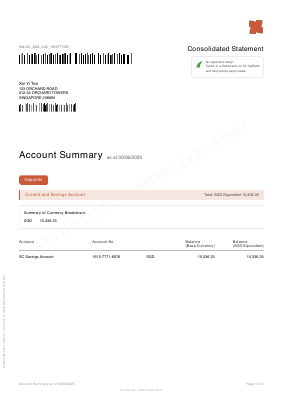

 USCredit Card4 pages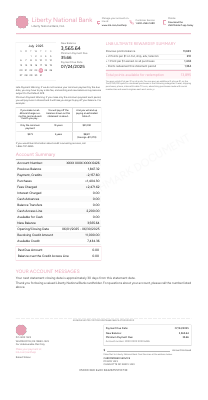

 NLBank Statement3 pages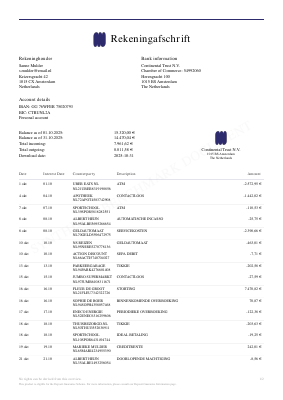

 HKBank Statement5 pages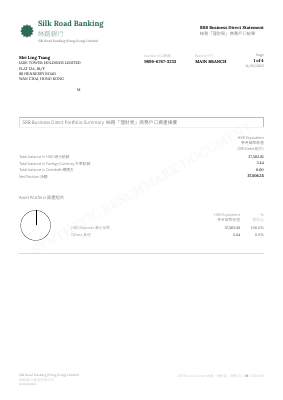

 CABank Statement2 pages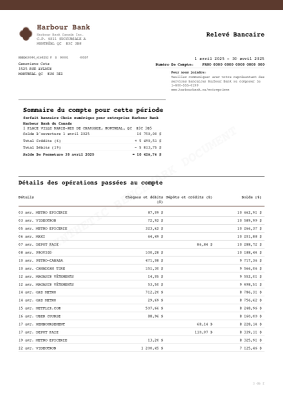
Intermediate5 statements
 MXBank Statement1 pageCACredit Card1 page
 AUBank Statement1 page
 GBBank Statement1 page
 INBank Statement27 pages
Advanced5 statements
HKBank Statement3 pagesSGCredit Card1 page KZBank Statement3 pages
 THBank Statement1 page
 MYCredit Card1 page
How Scoring Works
Your score is measured across two dimensions — the same framework we use to independently test commercial converters.
Extraction Accuracy
Field-by-field comparison of dates, amounts, descriptions, and balances against ground truth.
Statement Integrity
Balance reconciliation, total validation, and row-level alignment across the full statement.
Frequently Asked Questions
For Developers
Download the dataset, integrate the evaluation API, and benchmark your parser.
For Teams Evaluating Parsers
See how your current solution performs, or try Bankstatemently on your own statements.
Try Bankstatemently Free